Echelon Collective is a participant in the Amazon Services LLC Associates Program. As an Amazon Associate we earn from qualifying purchases. This costs you nothing and never influences what we recommend. Full details on our affiliate disclosure page.
Nothing shifts an outfit into autumn faster than changing your shoes. You can wear the same jeans and the same knitwear you wore in September, swap sneakers for suede boots, and the whole look moves seasons.
The problem is that most men own one pair of boots doing four jobs badly: too rugged for the office, too formal for the weekend, too delicate for rain. Three silhouettes cover essentially every autumn occasion. Here is how to choose between them, and which one to buy first.
The Three Silhouettes That Matter
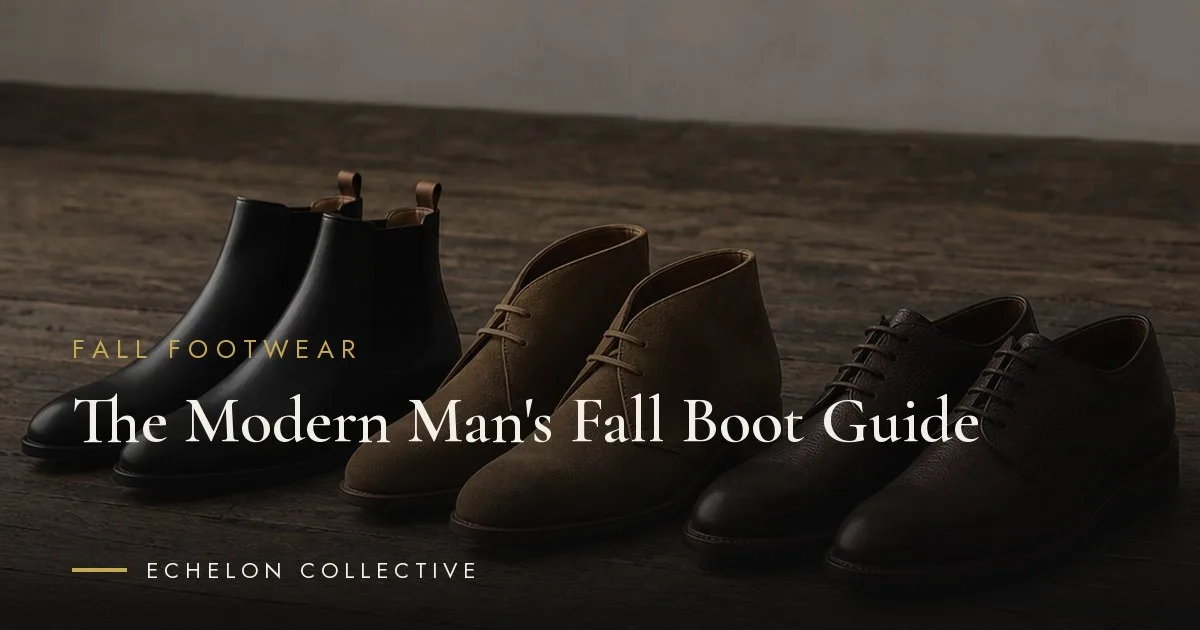
The Chelsea Boot
What it is. Ankle height, elastic side panels, no laces, a clean unbroken line from trouser to toe.
Why it works. The most formal of the three and the easiest to wear. The absence of laces creates a continuous line that flatters under trousers and slims the ankle. It is the boot that works with tailoring without looking like you brought hiking gear to the office.
Wear it with. Wool trousers, dark denim, tailored chinos. Under a topcoat it is close to unbeatable.
Watch for. Elastic quality determines lifespan. Cheap elastic slackens within a season and the boot never fits properly again. This is where paying more genuinely returns value.
Suede for weekends, polished calf leather for the office: shop suede Chelsea boots or shop leather Chelsea boots. For the longer argument on this silhouette, read Why Every Gentleman Needs Quality Chelsea Boots.
The Chukka Boot
What it is. Ankle height, two or three eyelets, open lacing, unlined or lightly lined.
Why it works. The most versatile of the three and the most forgiving if you are new to boots. Lighter and less imposing than a Chelsea, casual enough for weekends but clean enough for a smart-casual office. In suede it is arguably the single most useful autumn shoe a man can own.
Wear it with. Chinos, denim, casual wool trousers. The natural partner to a field jacket.
Watch for. Sole choice changes the character entirely. A crepe sole reads relaxed and weekend; a leather sole reads considerably sharper. Decide which job you are buying it for.
Best in sand, tobacco, or dark brown: shop suede chukka boots.
The Derby Boot
What it is. Ankle height, open lacing across a full quarter, more structure and often a heavier sole.
Why it works. The most substantial and the most weather-capable. Where a Chelsea is elegant and a chukka is easy, a derby boot is durable. It is the one to reach for when the forecast is bad but you still need to look serious.
Wear it with. Heavier trousers, denim, moleskin. It pairs with structured outerwear.
Watch for. Bulk. A derby boot with too heavy a sole tips into workwear fast, which is fine if intended and wrong if not.
Best in dark brown or black pebble grain: shop leather derby boots.
Which to Buy First
It depends on where you actually spend your days.
| Your situation | Buy first | Why |
|---|---|---|
| Office-based, business casual | Chelsea in dark brown leather | The only boot that genuinely works with tailoring |
| Mostly weekends and casual | Chukka in suede | Widest range of casual outfits |
| Commute on foot, wet climate | Derby in pebble grain | Handles weather without special care |
| You own zero boots | Chukka in dark brown suede | Highest chance of working with your existing wardrobe |
If you buy only one pair this season, make it a dark brown suede chukka. It is the boot most likely to work with clothes you already own, at the most reasonable entry price of the three.
Suede or Leather?
The question that stalls most purchases.
Suede reads softer, more autumnal, and more expensive than it usually is. It is the better choice for casual wear and the more interesting choice visually, because texture does work that color cannot. It is not as fragile as its reputation suggests, provided you protect it once before first wear and re-treat a couple of times per season. Shop suede protector spray.
Smooth leather is more formal, more weather-resistant, and easier to maintain. If the boot is going to the office under wool trousers, choose leather.
Pebble grain is the practical middle. It hides scuffs and water marks better than smooth leather, at the cost of a little formality.
What Actually Determines Quality
Ignore brand names for a moment and check these four things.
1. Construction method. Goodyear-welted or Blake-stitched boots can be resoled, which means a well-made pair lasts a decade rather than a season. Cemented (glued) soles cannot be repaired. When the sole goes, the boot is finished.
2. Leather grade. Full-grain outlasts corrected-grain substantially and develops character rather than cracking. “Genuine leather” on a label is, counterintuitively, a low grade.
3. Lining. A fully leather-lined boot breathes and molds to your foot. Unlined suede is fine and lighter. Synthetic lining traps moisture and shortens the life of the boot.
4. Heel counter and fit. The boot should hold your heel with almost no slip from the first wear. Boots stretch across the width; they do not shorten in length. Buy your measured size.
The resoleable-versus-not distinction is the one that matters most financially. A $250 resoleable boot worn for eight years costs less annually than a $120 glued boot replaced every two.
Care: Fifteen Minutes a Season
Boots fail from neglect far more often than from wear.
Suede. Protector spray before first wear. Brush after each wear with a suede brush and cleaning kit. Re-treat twice per season. Never apply a water-based cleaner.
Leather. Condition every six to eight weeks in autumn with a proper leather conditioner. Use cedar shoe trees between wears; these do more for shoe lifespan than any other single item, and they are inexpensive. Shop cedar shoe trees.
Both. Never dry wet boots near direct heat. It cracks leather and stiffens suede permanently. Room temperature, stuffed with paper, away from radiators.
Rotation. Do not wear the same pair two days running. Leather needs a day to dry out fully. This alone can double the life of a pair.
Pairing Boots With the Rest of Autumn
Boots are the anchor, not the outfit. For the pieces that build around them, see our fall transition wardrobe guide, and for outerwear that works over boots, our executive outerwear guide.
One rule worth following: match your belt leather to your boot leather. Brown boots, brown belt. It is the detail that most reliably separates considered dressing from accidental dressing.
For more on the philosophy behind buying fewer, better pieces, read The Ultimate Old Money Style Accessories Guide for Men.