
Echelon Collective is a participant in the Amazon Services LLC Associates Program. As an Amazon Associate we earn from qualifying purchases. This costs you nothing and never influences what we recommend. Full details on our affiliate disclosure page.
Most men have never worn a garment that actually fits them.
They have worn clothes that were close. Clothes that were acceptable. A jacket that looked correct in the mirror at the shop and never quite sat right again. The shoulder that lifts when the arm moves. The collar that stands away from the neck. The trouser that breaks in the wrong place. These are not failures of taste or of money. They are the predictable result of buying garments cut for an average that no individual man actually is.
Bespoke tailoring exists to answer that problem, and it is one of the few remaining corners of menswear where the word means something specific and verifiable.
What Bespoke Actually Means
The term is borrowed and misused constantly. It has been attached to watches, kitchens, holidays and software. In tailoring it has a precise definition, and it comes from the language of the trade: cloth that had been spoken for by a particular customer was said to be spoken for. Bespoke.
A genuinely bespoke garment has three characteristics:
- An individual paper pattern is drafted for you, from your measurements alone, and kept on file. It is not an existing block adjusted at the margins.
- The garment is cut and largely constructed by hand, by a cutter and tailors who can shape the cloth to the body rather than force the body into the cloth.
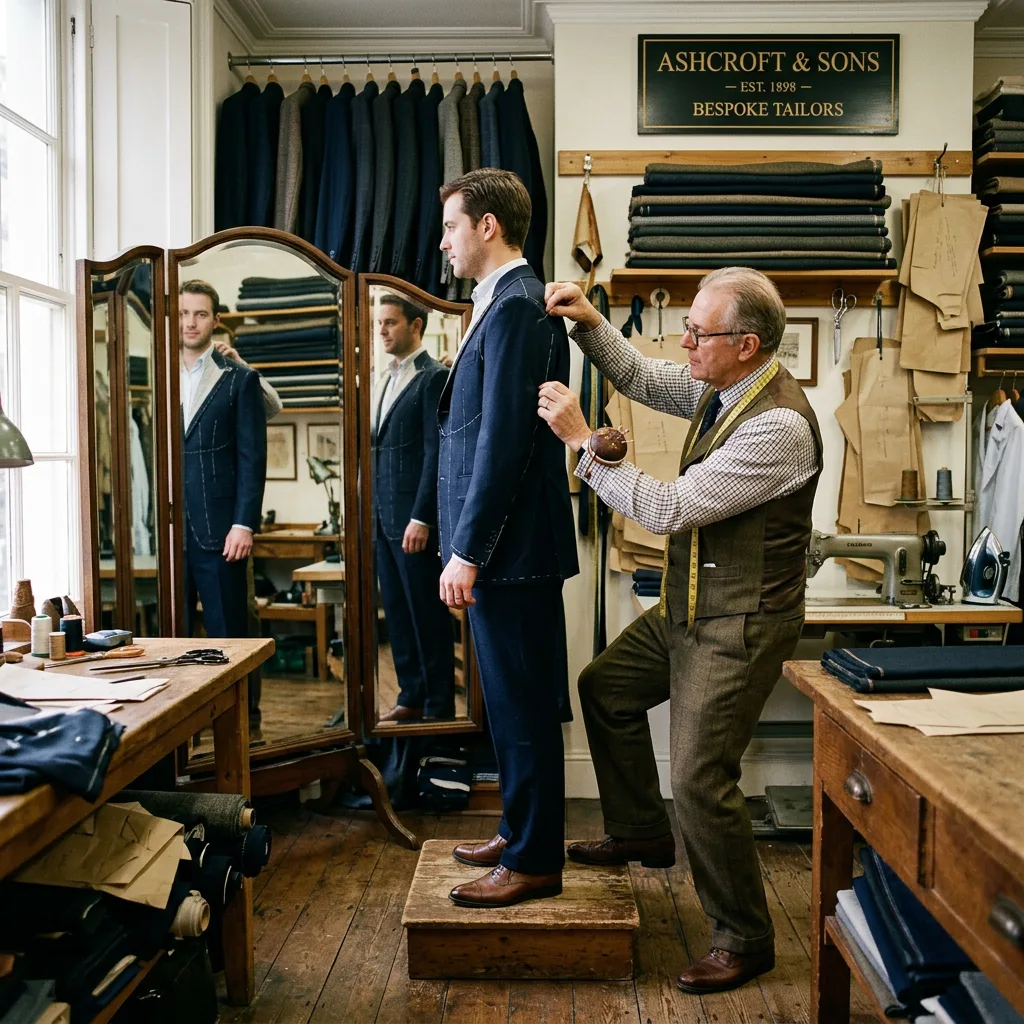
- There are multiple fittings, typically two to four, during which the half-made garment is worn, marked, taken apart and recut.
That third point is the one that separates bespoke from everything else. A bespoke suit is not measured and then delivered. It is built in stages, in the presence of the man who will wear it, and corrected at each stage against the body itself.
Bespoke, Made-to-Measure, and Off-the-Rack
These three are routinely confused, often deliberately, by retailers with an interest in blurring the line. The distinction is worth holding onto.
Off-the-rack is a finished garment cut to a standard size. It is made for a statistical composite of men. It can be altered — the waist taken in, the sleeves shortened, the trouser hemmed — but the fundamental architecture of the chest, shoulder and armhole is fixed before you ever see it. A well-chosen off-the-rack jacket in a size close to your frame, properly altered, can look genuinely good. Most men would be better served buying one well-fitting tailored-fit wool blazer than three ill-fitting ones.
Made-to-measure starts from an existing pattern block and modifies it to your measurements within defined limits. The lengths, the waist suppression, the sleeve and often the shoulder can be adjusted. It is produced largely by machine, usually with one fitting or none. It is a substantial improvement on off-the-rack for men whose proportions are unusual, and it costs a fraction of bespoke.
Bespoke begins with no pattern at all. The cutter draws yours. Every subsequent decision — the balance of the garment, the height and shape of the armhole, the pitch of the sleeve, the run of the lapel — is made for one body.
The practical way to read the three: off-the-rack fits the size, made-to-measure fits the measurements, bespoke fits the man.
The Art of the Perfect Fit
Fit is widely misunderstood as tightness. It is not. A garment that grips the body is not well fitted; it is small. Fit is the relationship between the cloth and the frame beneath it — where it touches, where it floats clear, and how it behaves when the man inside it moves.
A tailor reads a body the way a builder reads ground. No two are level. One shoulder sits lower than the other in almost every man. The spine has a forward or backward pitch. One blade is more prominent. The stance is slightly open or closed. A bespoke pattern records all of it, and the finished garment absorbs those asymmetries so completely that the wearer appears symmetrical.
The details a trained eye checks first:
- The collar. It should rest against the shirt collar along its whole length and stay there when the arms rise. A gap here is the most common and most visible fault in ready-made tailoring.
- The shoulder. The seam ends where the shoulder ends. The line runs clean, without a divot below the seam or a ripple above it.
- The armhole. Cut high and close, which sounds restrictive and is the opposite. A high armhole lets the arm move without dragging the whole body of the jacket with it.
- The chest. Clean, with no horizontal pulling at the button and no hollow above it.
- The trouser. Hung from the waist, not gripped at the hip, with a break that touches the shoe without collapsing onto it.
The same standards apply to shirting, where poor fit is easier to see and cheaper to correct. A properly cut dress shirt should close comfortably at the neck, sit flat across the yoke, and have a sleeve that ends at the wrist bone so a half-inch of cuff shows beneath the jacket.
Why Fit Changes How a Man Carries Himself
There is a practical argument for bespoke and there is a less obvious one. The practical argument is comfort. A garment cut to your frame does not need to be managed. You are not adjusting the collar, tugging the hem, shifting the shoulders or unbuttoning to sit. Over a twelve-hour day, that absence of friction is not a small thing.
The less obvious argument is what it does to posture and bearing. Men stand differently in clothes that fit. The habitual small corrections disappear, the shoulders settle back, and the result reads to everyone else as ease. A distinguished appearance is rarely the product of an expensive garment. It is the product of a man who is not thinking about what he is wearing.
This is also why fit outranks label. A modest cloth cut precisely will outdress a prestigious cloth cut carelessly, every time and without exception. It is the same principle that underpins quiet luxury: the quality announces itself through proportion and construction, not through branding.
What Bespoke Costs, and What You Receive
Bespoke is expensive, and it should be described honestly. A suit from an established house on Savile Row generally begins in the range of five thousand pounds and rises considerably from there. Skilled bespoke tailors outside the traditional centres — in Naples, in Hong Kong, and in most major cities — work at meaningfully lower figures. The commitment is time as well as money: expect several months and multiple visits for a first commission.
What that buys, beyond the fit:
- A garment that can be maintained. Hand construction can be opened, recut and let out as the body changes. A fused, machine-made jacket largely cannot.
- A pattern held on file. Every subsequent commission starts from a known, proven foundation.
- Full control of the cloth. Weight, weave, mill and season, chosen for the climate you actually live in.
- Longevity. A well-made bespoke suit, rotated properly and cared for, remains serviceable for decades.
Measured per wearing over twenty years, the arithmetic is far less alarming than the invoice. That is the honest case for it, and it only holds if the garment is genuinely worn.
When Bespoke Is Worth It, and When It Is Not
It is worth it when tailoring is genuinely part of your working life, when your proportions are poorly served by standard sizing, or when a specific occasion justifies the outlay. A man who wears a suit four days a week will extract more from one bespoke commission than from four ready-made ones.
It is not worth it if you wear tailoring twice a year, if your weight is currently moving, or if you have not yet established what you actually want. Bespoke rewards a settled sense of your own taste. Commissioning one before you have that tends to produce an expensive garment you do not reach for.
The sound intermediate step is to buy well off-the-rack and build a relationship with a competent local alterations tailor. Most men gain more from having three existing jackets properly adjusted than from any new purchase.
Building Toward Bespoke
If a first commission is somewhere ahead of you, the interval is best spent narrowing your taste and raising the standard of what surrounds the suit. A bespoke jacket over neglected shoes and a tired belt is a wasted commission.
Worth attending to first: a navy wool suit in a tailored cut as the foundation of the wardrobe, a small run of white and pale blue shirts in decent cotton, a full-grain leather belt matched to your shoes, and a few woven silk ties in solid or restrained patterns. Knowing how to tie them properly matters more than owning many.
Footwear carries the whole arrangement. Our guide to business-casual shoes covers the ground in detail.
Caring for Tailored Clothing
Tailoring is destroyed far more often by poor care than by wear. The rules are few and they are not demanding.
- Rest the garment. Never wear the same suit two days running. Wool needs a day to recover its shape.
- Hang it correctly. A shaped wide-shouldered wooden hanger preserves the line of the shoulder. Wire hangers ruin it.
- Brush, do not clean. A natural-bristle clothes brush after each wearing lifts dust and removes the need for most dry cleaning, which is harsh on wool and should be reserved for actual stains.
- Steam rather than press. A handheld steamer releases creases without flattening the hand-shaped roll of the lapel.
- Store it protected. A breathable cotton garment bag and cedar in the wardrobe deal with the two genuine threats, which are moths and damp.
The Echelon Standard
Bespoke tailoring is not a purchase. It is a relationship with a craftsman who comes to know how you are built and how you move, and who records that knowledge in a paper pattern held in a drawer with your name on it.
Reaching that point is not urgent, and it is not a prerequisite for dressing well. Fit is. A man in a corrected off-the-rack jacket that sits cleanly on his shoulders is better dressed than a man in an expensive one that does not, and the room registers the difference long before it registers the label.
Buy less, fit it properly, and maintain it. That is the whole of it.
Our full selection of wardrobe essentials is collected in the Echelon Collective storefront.
Related Reading
- Mastering Quiet Luxury in Men’s Fashion
- Modern Gentleman Capsule Wardrobe
- Top 10 Business Casual Shoes for Men
- How to Tie a Neck Tie: 5 Essential Knots Every Man Should Know
- The Ultimate Old Money Style Accessories Guide for Men


You must be logged in to post a comment.